


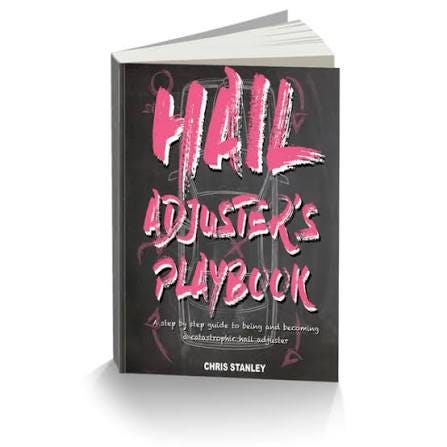
I made two big mistakes with my first book, the Hail Adjuster’s Playbook.
The cover was terrible, hard to read.
I wrote a how-to book without a new point of view.
You might be thinking, ‘Wait a second Chris, I’m not supposed to write a how-to book?”
Write all the how-to books you want. Just not before giving people a new way to frame your instructions.
See I was wanting to set my business and myself up as something people would never forget. Problem was I didn’t give them anything to remember me as.
Adjuster training already existed. People already had beliefs about it. I showed up and taught them how to do a thing in a category and way they already believed in. I affirmed their point of view, I didn’t give them a new one.
I gave them some good information and it got me some kudos, good reviews, and attaboys, but not really many clients.
Then I wrote my second book, Independent Adjuster’s Playbook, and it all changed. People starting hiring me, the difference was nearly instant.
I had someone this week DM me on LinkedIn saying “Just started reading Mini Book Model, good stuff.”
They were a fellow author and I wanted to remark, “That isn’t my best book in that series, but everyone seems to like it best.”
So I thought about my IA Playbook. I thought about Mini Book Model, why they got most the love.
Then it hit me…
Both of them don’t just tell you how to do something, they make you believe something new.
How I ‘Accidentally’ Claimed a Spot in People’s Mind
I wrote my 2nd book, Independent Adjuster’s Playbook, and the thesis was,
“The way your trying to do this, is wrong. Here’s why and what you should do instead.”
The first quarter of the book was me breaking down the normal way of thinking in our industry and offering an alternative.
I offered a new way to see our industry, instead of getting work with houses= claims, get work with auto claims.
It was a simple switch, but it landed. People started calling me “the Auto Guy.”
They started asking for Virtual Adjuster Mentorships. (the category I set up with that book) Other companies started modeling my language and the way I did things. (which grew my category)
The book worked.
Why It Worked
What I didn’t realize at the time, was that I had created a new category in people’s minds, because of the first 25% of that book.
Now I don’t just mean the technical category name “Virtual Adjuster Mentorships”, I mean new real estate in their minds.
It’s where “the auto guy” term they all seemed to parrot comes from. They slotted me in this spot they didn’t know existed before.
So two nights ago just before bed I had an epiphany…
If the primary thing I’m selling, if my category is primarily built around intellectual property, I have to write a book that makes the case for taking up real estate in people’s minds.
Companies with physical categories like, Uber, just need to convince you to take 1 ride and you have the epiphany. Drive a Cyber Truck and you’ll get why its different.
The only way for me to get someone to test drive intellectual property is to let them read and experience thinkers high of a new way to see and solve a problem.
I can’t just tell them “how to do the thing.”
I have to make the case for my category, for my spot in their mind. If I choose a category or space in someone’s mind where other people already take up space it’s too competitive.
I’d then have to convince them to replace that person with me and that’s not a fight I want to have.
Same thing happened when I intentionally wrote the Mini Book Model.
I set out to become known as the “Mini Book guy” and to establish Mini Books as a legit type of book.
I argued for Mini Books and against the “big book lie” that you have to write a 30k word manuscript to have a ‘real’ book.
I wrote more books in the series that were straight how-to.
Mini Book Writing - how to write a Mini Book in 7 days
Mini Book Publishing - how to publish your book to Amazon
Mini Book Marketing - how to sell your first 1000 books
Mini Book Money - how to create products around your books
People ‘like’ those books, but they tell me they ‘love’ Mini Book Model.
Took me a while to understand that. Love and use are two different jobs. Mini Book Model changed what they thought was allowed. The other four they actually open when they sit down to work.
Both matter. Only one of them claimed the category.
People Want Their Minds Changed
A good friend and client of mine Stuart Corrigan sent me research yesterday that explains some of the why and validated a theory of mine.
The research shows that people want their minds changed.
I get this from the 2025 Edelman-LinkedIn B2B Thought Leadership Impact Report, survey was of 1,934 business executives in business from 1-1000+ employees.
What they found helps us realize how to make sales and get customers, especially in a B2B context. In B2B, which I often operate in, there are different types of decision makers.
Sure there is the guy your talking to trying to sell, but then there is the person(s) who actually make the decision behind the scenes. They call these the “hidden decision-makers.”
All that to set up the way the stats fall out.
The two most striking statistics are this,
86% of hidden decision-makers want fresh perspectives that challenge assumptions rather than validate their thinking.
91% of hidden decision-makers say a hallmark of quality is helping them uncover challenges or needs they hadn’t recognized, versus 81% of target decision-makers.
81%+ of decision makers are looking for thought leaders and people to help them see challenges or needs they didn’t know about.
They are begging for someone to create a category (a way of thinking) and present it to them!
Decision makers are wanting someone to do the hard thinking for them and present a new point of view… a new solution… a new category.
This is why books like Atomic Habits, Building a Storybrand, Play Bigger, The Existing Market Trap, do so good at creating a category.
They each present a new way of thinking, often to an existing obvious problem, but as a result the author and company behind the book gets known as the leader of the category.
They become a category king or a category of one.
How to Write a Book That Gets You Customers
Hopefully I’ve shown you that just writing a how-to book doesn’t guarantee you’ll get customers.
I’ve experienced it, both a book that moves the needle in business and one that provides royalties but doesn’t establish a category.
How to books have a place, they serve the category they belong to… but they don’t establish the category.
Only by publishing a book that names and frames your category, a new way of thinking, a new solution, can you claim a category with a book.
Then you can write how-to books inside that category. Otherwise you are writing and helping someone else’s category get bigger.
The intetional process of claiming your category with a book is Category Publishing.
Here are the steps I see when I break down my books that established a category and when I look at other famous books like Atomic Habits.
You can write “how-to”, but the first 25% must change how people think and give them a new frame for the “how-to” to sit inside.
The part that surprised me when I broke down the famous ones.
Atomic Habits is mostly how-to.
Building a StoryBrand is mostly how-to.
The 5 Love Languages is mostly how-to.
James Clear spends three chapters on why goals fail and seventeen on what to do instead.
The teaching in my first books was never the problem.
The first 25% of a book decides whether the teaching belongs to you or to someone else and their category. that is where the problem takes hold.
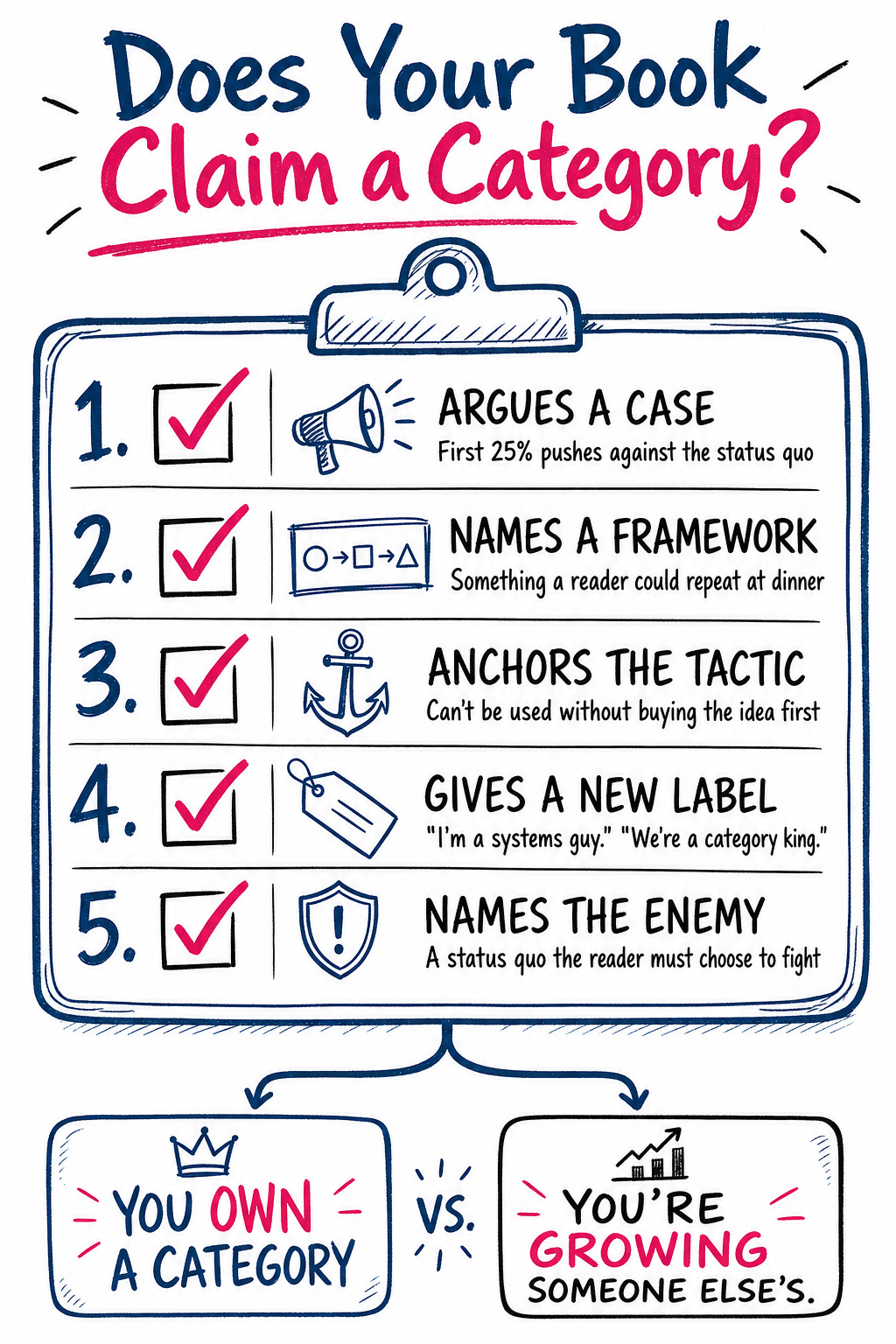
So here are 5 things a Category defining book must have.
1. Does the first quarter of the Mini Book argue against something?
This is an argument against the status quo way of thinking. Remember the research, decision makers don’t want validation, they want problems they didn’t see, new ideas and solutions.
2. Is the framework named and owned?
Magic triangle. Storybrand Script. Five Love Languages. Category Kings. 13 Deadly Sins. If your framework and way of thinking has no name, you built a how-to. If someone can repeat your mechanism’s name at dinner, you built a framework that can be remembered.
3. Can someone use your framework without buying your idea?
Try lifting one tactic out of your book. Hand it to someone who never read it.
Anybody can use “lay your gym clothes out the night before.” Nobody can use “name, frame, and claim a category” without first agreeing with Play Bigger. Portable tactics grow other categories. Anchored tactics grow yours.
4. Does the reader get new language?
“I’m a words of affirmation person.” “I’m a systems guy.” “We’re a category king.” Readers should walk away with a name for something if they apply what they learned. If it can provide new language for them in their life and business your doing category publishing.
5. Does it name the enemy the reader is currently fighting?
An enemy must be named. The reader must choose to fight against this thing to apply your new way of thinking. If you wanted to be a Mini Book Author, you’d have to fight the Big Book Lie that says a book must be 30k+ words.
I wrote five how-to books after Mini Book Model. They sell every day inside a category I own.
I just happened to have written them in the right order that time. I want to make sure you do the same.
Keep spinning.
Coach Chris
P.S. If you need help with your book ask questions in the comments. Happy to help.
Chris, the part about the first 25% doing the real category work makes a lot of sense. A lot of books give useful steps, but they never give me a reason to see the problem in a new way first. Then the advice feels easy to forget. Your line about portable tactics growing someone else’s category was sharp too. It made me think of how often people share tips from a book but never mention the core idea behind it. That seems like the real test.
Absolutely LOVE this, Chris!
You’re a pirate through and through!