


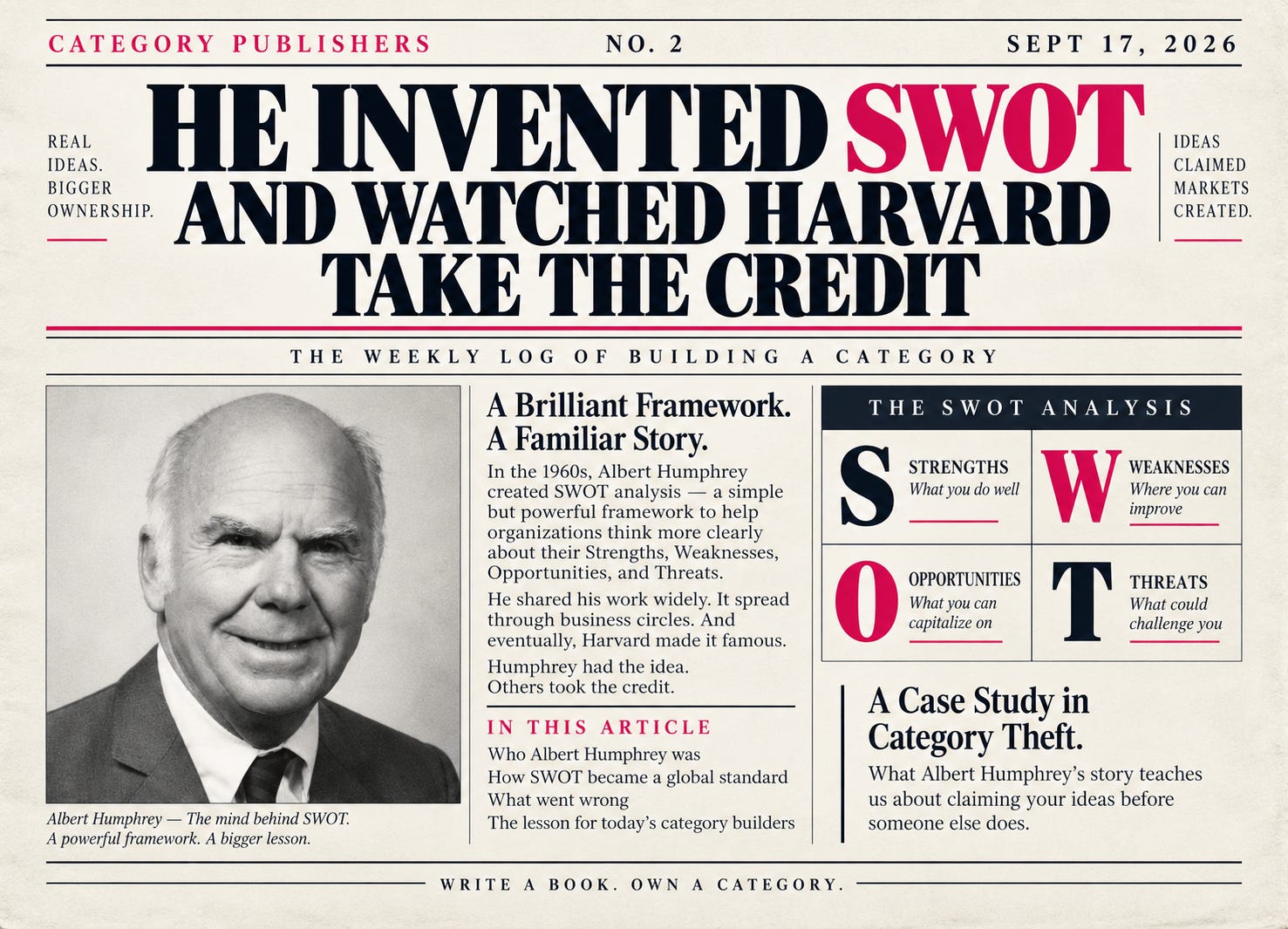
He built the framework the whole business world uses. Few know his name.
The same thing is happening to your idea right now.
The whole goal in being a category publisher, in creating your own category, is so you stand out, if not stand alone.
The world has too many books already. (there I said it, heresy I know)
But if you are just going to say the same thing everyone else says, why say it?
The way you stand out is by writing to 1 specific person, helping them solve 1 clear problem, with a unique POV. (Point of view)
1+1+1 = potential $$$
Using new language to do it makes you memorable and gives you a clear identity to stand on.
Category Language
Once you have a category name, nailing your category villain and problem is the next thing to identify.
Typically, your enemy is the typical way of doing things.
Whatever 90%+ of the world says is how you do something, fight that, punch at that idea.
Your unique POV, your life experiences typically has villain that your readers need defeated.
When I write for independent insurance adjusters my enemy was the “Adjuster Lottery.”
It characterized everything about the industry I hated.
But it was what EVERYONE said to do.
Get a license
Get some basic training
Get on some companies
Wait on a list with 10,000+ other people
Wait for a hurricane to hit so you are needed
To me that was lottery level chances you’d actually make money so I referred to all that as the Adjuster Lottery.
It shaped my book, I used gambling metaphors, talked about casinos “The House Always Wins.”
I tell you all this, because this is why we do the work BEFORE we sit down to write. Everything I wrote and talked about became improving the odds of my readers.
When I write Mini Book Model I had to find an enemy.
The Big Book Lie is my categories enemy.
People know they need to write a book, but they get intimidated by having to,
write 40,000 words
bleed over the page for months if not years (the longer the better)
spend thousands of dollars on cover designers, editors, formatters
get 1000 beta readers before you launch your book
be consumed in your life having to perform launch lunacy and do 100 podcast interviews to market your book
That’s all the old way of thinking.
That’s the Big Book Lie that publishers and high thinking “self publishers” say you HAVE to do.
It’s bull crap and it isn’t what you have to do.
You can write a 20,000 word or less Mini Book in a few days. Spend $500 or less to publish it. And it be released that same month.
This is what all the Mini Book series was fighting against, but I set it all up in Mini Book Model as the evil villain and each book is all of us fighting against it.
Category Publishers Villain
So as I push deeper into publicly developing the Category Publishing category, I’m spinning on the enemy.
The big thing I believe people have to fear is creating their category, creating a beautiful slide deck. Writing a great speech. Delivering a lightning strike moment to unveil the category and never actually claiming their category.
This is the Deck Delusion.
Just because you wrote and said it on social media (FYI Substack is social media) doesn’t mean you own a category or are the published author of something.
But this isn’t the main enemy.
People also bury their category it in Substack, X, and LinkedIn posts and someone else picks up the mantle and runs with it.
Because a post on Substack is NOT claim to a category. It’s content, which is helpful to flush it out, but does not actually put a real authoritative stake in the ground to say “This is the ground I’m standing on for the next few years.”
To have people take you seriously you have to write a category claiming book, not just a long newsletter.
Or worse that you never even figure out what their category actually is and someone else comes and claims it out from under their nose putting a name to what it was you were trying to do.
And thats when it hit me. Amidst all my ramblings to my wife and to AI trying to flush out what the big thing to fear was. The boogey man people didn’t even know if it existed I found an enemy.
Category Theft.
When someone takes the category you have worked on (knowingly or not) and claimed it as their own.
Just because you wrote the newsletter on it doesn’t mean your the authority on a category. (yes, a Mini Book on Substack is still just a long newsletter, it isn’t authorship as the world defines it)
To be the authority of a category you have to AUTHOR a book on it.
Until you do your just a guy or a gal on Substack.
The moment you publish your category… now you are a Category Publisher.
Category Theft in the Wild
Atomic Habits spent 5 years on the NY Time bestseller list… 5 FREAKING YEARS.
It has sold 30 million copies worldwide.
BJ Fogg, a Stanford behavior scientist, had been publishing research on small habits for decades before Atomic Habits came out.
He didn’t release his book until a year after James Clear defined the category. He wasn’t just 12 months late. He never defined it.
When his book finally came out it read as “oh, another book on atomic habits.” After DECADES of work.
He didn’t name the ground he was standing on, so somebody else did. With a book.
James Clear knowingly or not (he’s a smart guy pretty sure he knew he was defining a new category) created the category of Atomic Habits.
SWOT was developed over 60 years ago and there is NO CLEAR CREATOR of this way of business Analysis.
SWOT is an acronym that stands for Strengths, Weaknesses, Opportunities, and Threats.
They can’t even agree if Stanford or Harvard first came up with it.. .because no one AUTHORED THE BOOK ON IT.
Albert S. Humphrey worked on the Stanford Research Institute planning project that produced SWOT, from 1960 to 1970. He watched Harvard and MIT get the credit for it.
So he wrote the correction. A paper saying he’d been told that those Universities claimed it, and that this is not so.
He wrote the claim on it and died before it got printed.
Six weeks later it ran on page seven of an alumni newsletter.
Sixty years later, every business school on earth teaches his framework and can’t tell you his name.
Category Theft.
Your category isn’t claimed, you aren’t the author of it, until you write and publish the book on it.
Your Turn to Find Your Enemy
I’ll walk you through how to find your enemy.
First you have to start with clearly identifying your problem. If you haven’t done that, you gotta go back.
Typically you nail down,
The person you are writing to
The problem they face
The unique POV you have that will help them solve this problem.
Once you have that you can begin working on your Category Name.
But look at the problem you are helping solve.
Here is my example of Category Publishing,
Person: someone who is trying to create a category for them and their company
Problem: they aren’t known as the leader of their category
POV: Writing a Mini Book and publishing it to Amazon is the quickest most definitive way to claim a category.
The villain that they don’t see that is wreaking havoc, that they aren’t even aware of until I name it is… Category Theft.
If you don’t solve the problem the boogie man will get you, someone will steal your category.
So what is the big evil thing lurking behind the problem you solve?
What will “get them” if they don’t eliminate this problem once and for all?
As I see it you can go two ways with this.
Name the normal way of thinking the enemy (Big Book Lie, Deck Delusion)
Name the thing that will get them if they don’t solve the problem (Category Theft)
I’ve created a prompt below for those who support this newsletter that’ll help you find your enemy name
Keep writing and claiming your life.
Chris Stanley
The Enemy Finder
There are 3 fields right at the top you have to write in your answers then paste this into the AI of your choice.
It’ll ask you question after question giving you new enemy names each time until you find a enemy worth fighting.
